

The Impact of Trauma on the Body: A Somatic and Polyvagal Perspective

Trauma is often thought of as something that lives in the mind, like a memory, a story, or a past event. But from a somatic and neuroscience-informed perspective, trauma is just as much a physiological experience as it is a psychological one. The work of researchers and clinicians like Stephen Porges, Bessel van der Kolk, and Elizabeth Stanley highlights a fundamental truth: trauma lives in the nervous system. It is not simply what happened to a person, but how their body responded and whether that response was able to fully resolve. Understanding how trauma lives in the nervous system is essential for effective healing.
Before we understand what’s happening in the body, we have to understand the difference between stress, chronic stress, and trauma. While often used interchangeably, stress and trauma are distinct processes. Stress is a natural and often adaptive response to challenge. When we encounter something demanding, the body mobilizes—heart rate increases, adrenaline or cortisol spikes, attention sharpens, and energy becomes available to respond. Ideally, once the stressor passes, the body returns to baseline. Acute stress can be adaptive; it mobilizes the system for action (fight or flight), enhances focus, and supports survival. Stress can be both positive and negative depending on the context. For example, some positive forms of stress might include an athlete competing in a race, purchasing a first home, or transitioning into college. Stress can also be negative and chronic, such as when dealing with a chronic health condition or an overbearing boss. Physiologically, the body may experience these events in a similar way, but the brain is processing them differently.
Trauma, by contrast, occurs when an experience overwhelms the nervous system’s capacity to cope, integrate, and recover. It is not defined solely by the event, but by the body’s inability to process and discharge the activation associated with it. This state of “nonrecovery” often occurs when an individual feels powerless and is unable to protect themselves from harm. Trauma results in dysregulation, where the nervous system becomes “stuck” in patterns of hyperarousal or hypoarousal.
As van der Kolk (2014) emphasizes, “trauma is not the story of something that happened back then; it is the current imprint of that pain, horror, and fear living inside people.”
The Nervous System and Polyvagal Theory
Polyvagal Theory, developed by Stephen Porges, offers a powerful framework for understanding this. It describes how our autonomic nervous system continuously scans for cues of safety or danger and shifts between different states accordingly. When we feel safe, we are in what is called the ventral vagal state. This is where connection, curiosity, and emotional regulation are possible. When we perceive threat, the body shifts into a sympathetic state of mobilization, often experienced as anxiety, urgency, or fight-or-flight activation. If the threat feels overwhelming or inescapable, the system may instead move into a dorsal vagal state of shutdown, which can feel like numbness, collapse, or disconnection. In a well-regulated system, we move fluidly between these states. Trauma disrupts that flexibility, often leaving individuals stuck in patterns of chronic activation (e.g., anxiety) or shutdown (e.g., depression).
The Window of Tolerance
This is where the concept of the “window of tolerance”, a concept popularized by Dan Siegel, becomes especially useful. The window of tolerance refers to the range of arousal within which a person can function effectively, such as where emotions are manageable, thinking is clear, and the body feels relatively safe. Trauma tends to narrow this window. As a result, individuals may find themselves more easily pushed into states of hyperarousal, such as anxiety or overwhelm, or hypoarousal, such as numbness or dissociation. Elizabeth Stanley (2019) emphasizes that trauma shifts the baseline of the nervous system, meaning that what once felt manageable may now feel intolerable, and regulation requires more conscious effort.
Within the window:
Emotions are tolerable and manageable
Thinking and feeling are integrated
The body feels relatively safe
Outside the window:
Hyperarousal (above the window; sympathetic activation): anxiety, overwhelm, panic, reactivity
Hypoarousal (below the window; dorsal vagal shutdown): numbness, disconnection, collapse
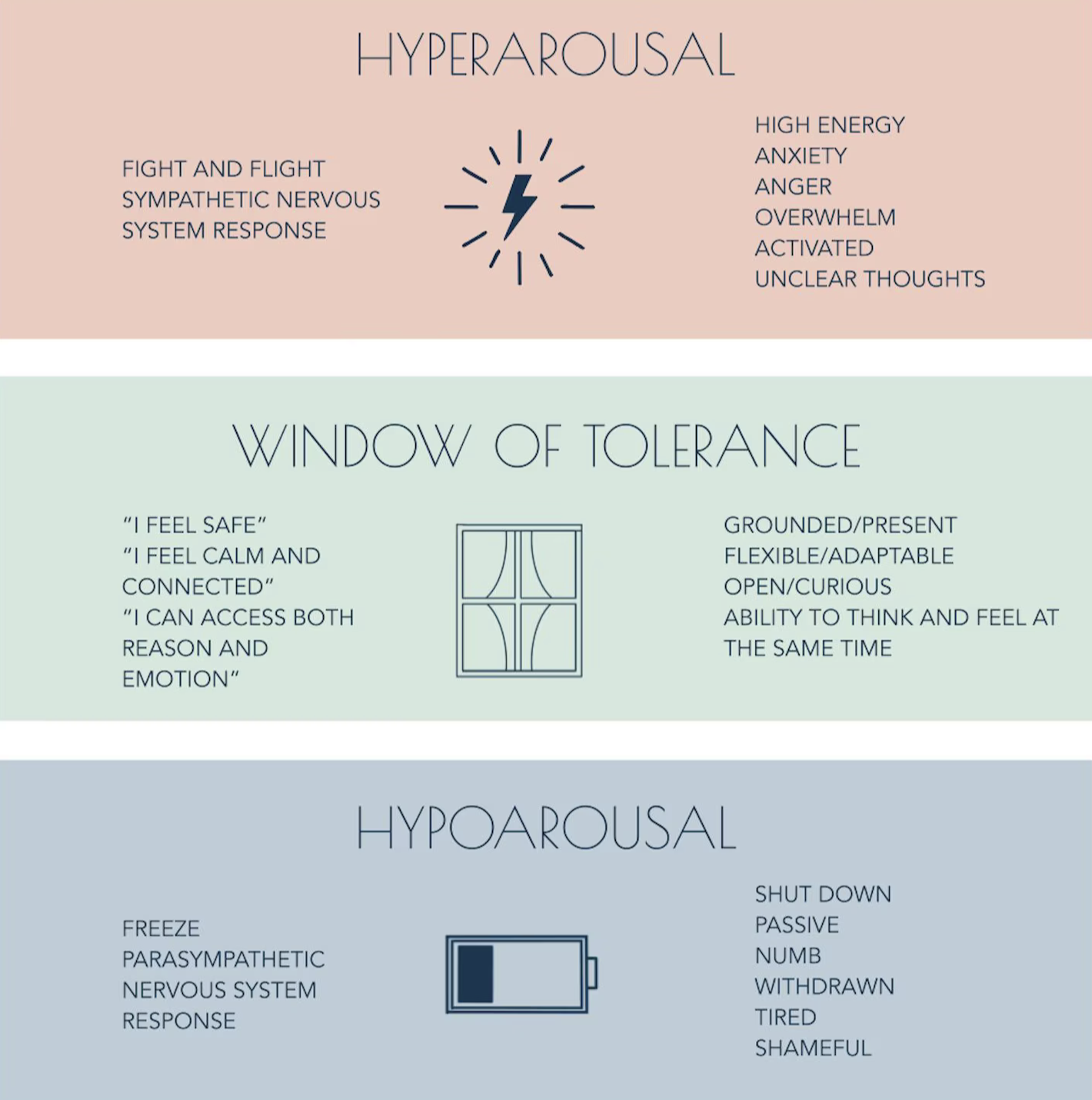
Window of Tolerance
The physiological effects of trauma are wide-reaching. Chronic nervous system dysregulation impacts the stress response system, including the hypothalamic-pituitary-adrenal axis (HPA Axis), which can lead to irregular cortisol levels and difficulty managing stress. It can affect cardiovascular functioning, resulting in increased heart rate or reduced heart rate variability, and often alters breathing patterns, leading to shallow or restricted breath. Many individuals also experience gastrointestinal symptoms, as the gut is highly sensitive to nervous system states. The immune system can become compromised or overactive, contributing to inflammation and increased vulnerability to illness. These are not abstract processes; they are lived, bodily experiences that can persist long after the original threat has passed.
Psychologically, trauma shapes how individuals perceive themselves, others, and the world. It often leads to hypervigilance, where the nervous system is constantly scanning for danger, even in relatively safe environments. It may confuse perceived threats with actual threats. Emotional regulation can become more difficult, with feelings either becoming overwhelming or, conversely, blunted. Many people develop deeply held negative beliefs about themselves, such as shame or unworthiness, and may struggle in relationships due to difficulties with trust and safety. Dissociation is also common, reflecting the body’s attempt to protect itself by creating distance from overwhelming experience.
One of the key insights from somatic approaches is that trauma is often stored as implicit memory. Rather than being held as a clear narrative, it lives in sensations, emotions, and patterns of response. This is why someone might feel anxious, shut down, or triggered without fully understanding why. The body remembers, even when the mind does not. As Peter Levine’s work in Somatic Experiencing suggests, trauma reflects incomplete defensive responses; energy that was mobilized for survival was never fully discharged.
Bottom-up, or body-based, approaches focus on working directly with the physiological experience of the nervous system. This is grounded in the understanding that trauma is often stored in implicit memory, through sensations, activation patterns, and reflexive responses, rather than in clear, narrative form. As a result, healing requires engaging with the body in a way that allows these patterns to be noticed, processed, and gradually reorganized. One of the foundational practices in this work is tracking sensations, which involves bringing gentle, nonjudgmental awareness to internal bodily experiences such as tension, warmth, tightness, or shifts in energy. This helps individuals build interoceptive awareness and develop a more attuned relationship with their internal state, which is often disrupted by trauma. Porges (2011) emphasizes that safety is not something we simply think about; it is something the body must experience.
Breathwork is another essential component, as the breath is one of the most direct ways to influence the autonomic nervous system. Slow, intentional breathing, particularly with an emphasis on longer exhales, can help signal safety to the body and support a shift out of sympathetic activation or dorsal shutdown. Importantly, breath practices are typically introduced gradually and with sensitivity, as some individuals with trauma histories may initially find breath awareness activating rather than calming.
Movement and discharge are also key elements, reflecting the idea that trauma often involves incomplete defensive responses. The body mobilizes energy for fight or flight, but if that energy is not fully expressed or resolved, it can remain stuck in the system. Gentle, intentional movement (e.g., stretching, shaking, pushing against a surface, or even subtle shifts in posture) can help the body complete these responses and release stored activation. This is not about catharsis, but about supporting the nervous system in finding resolution in a titrated and regulated way.
Grounding and orienting practices further support regulation by helping individuals connect to the present moment and their external environment. Grounding may involve noticing contact with the floor, feeling the support of a chair, or engaging the senses to anchor in the here-and-now. Orienting, a concept emphasized in somatic work, involves allowing the eyes and head to gently scan the environment, taking in cues of safety such as light, space, or neutral objects. These practices help counter the nervous system’s bias toward threat detection by actively reinforcing signals of safety, which over time can support greater stability and resilience.
Together, these bottom-up approaches help restore a sense of safety within the body, expand the window of tolerance, and increase flexibility in the nervous system. Rather than trying to think one’s way out of trauma, they create the conditions for the body to experience regulation directly, which is ultimately what allows for deeper and more lasting healing.
Trauma is a whole-body experience that reshapes the nervous system, physiology, and sense of self. Differentiating stress from trauma allows for more precise and compassionate care, while frameworks like Polyvagal Theory and the window of tolerance provide a roadmap for understanding dysregulation. Ultimately, trauma is not a life sentence. The nervous system is capable of change, and with the right support, individuals can expand their window of tolerance, regain a sense of safety, and reconnect with themselves and others. Healing is not about erasing the past, but about helping the body learn that the threat is no longer happening, and that it is safe, once again, to be fully present.
Healing requires more than insight; it requires working with the body to restore safety, flexibility, and regulation. When the nervous system can once again move fluidly between states, individuals regain access to connection, resilience, and a sense of aliveness.
If you or someone you know is struggling with their mental health, reach out for help today. At Cypress Wellness Collective, we can help. Cypress Wellness Collective is located in the San Francisco Bay Area where they specialize in therapy, nutrition counseling, and KAP for teens, adults, and families going through mental health challenges, including depression, anxiety, and eating disorders. They offer in person and virtual appointments throughout all of California. Call today for your free consultation to see if Cypress Wellness Collective is right for you!
References (APA Format)
Porges, S. W. (2011). The polyvagal theory: Neurophysiological foundations of emotions, attachment, communication, and self-regulation. W. W. Norton & Company.
Stanley, E. A. (2019). Widen the window: Training your brain and body to thrive during stress and recover from trauma. Avery.
van der Kolk, B. A. (2014). The body keeps the score: Brain, mind, and body in the healing of trauma. Viking.
Levine, P. A. (2010). In an unspoken voice: How the body releases trauma and restores goodness. North Atlantic Books.
Siegel, D. J. (1999). The developing mind: How relationships and the brain interact to shape who we are. Guilford Press.